

Understanding the Value of Le Violon d’Ingres
Some photographs become memorable because they document a moment, while others become cultural landmarks because they transform how an image can be understood. Man Ray’s 1924 photograph belongs to the second category, combining portraiture, painting, music, photography, and Surrealist wit in one carefully constructed composition. Its continuing relevance comes from the way a seemingly simple image can invite questions about artistic innovation, cultural history, rarity, and value.
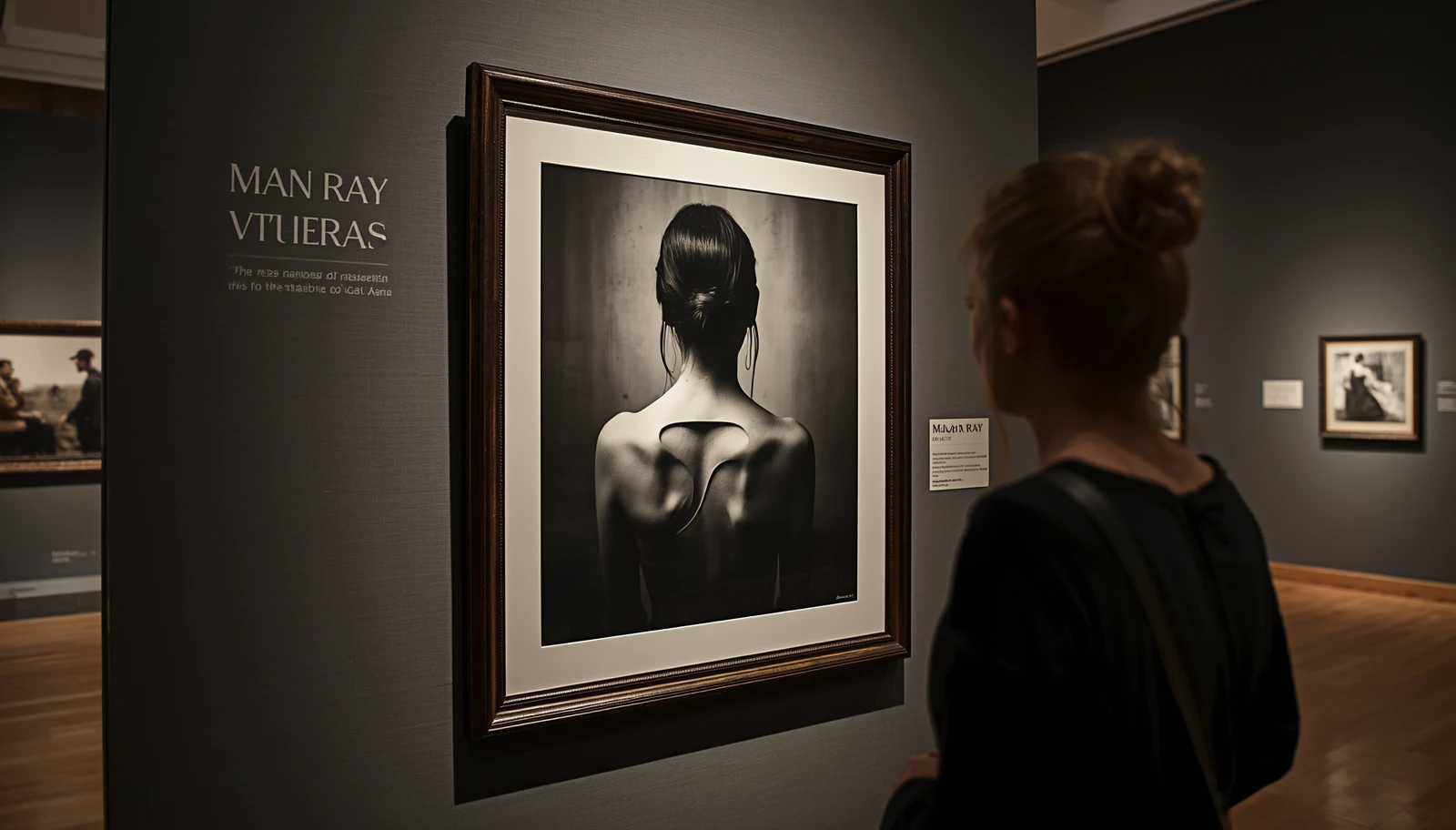
Le Violon d’Ingres remains particularly fascinating because its visual concept is instantly recognizable while its history becomes richer with closer examination. The photograph portrays Kiki de Montparnasse from behind and transforms her figure through violin-shaped marks inspired by the instrument’s sound holes. That unusual combination of classical art references and avant-garde photography helps explain why the image continues to attract museum attention, scholarly discussion, and collectors.
Why Le Violon d’Ingres Draws Attention
What makes this photograph so compelling is not simply its age or famous creator. The image turns a human figure into a visual pun, connecting Man Ray’s experimental approach with the tradition of European painting. Once that connection becomes clear, the photograph can be viewed as more than a portrait because every major element contributes to its layered meaning.
famous photography auction discussions often return to this work because its artistic importance and market history intersect unusually strongly. The photograph was created in 1924 and became associated with Man Ray’s Surrealist practice and Kiki de Montparnasse, one of the recognizable figures of Parisian avant-garde culture. This combination gives the image a distinctive position within twentieth-century photography.
Recognizing Its Visual Concept
Man Ray borrowed the reclining pose associated with Jean-Auguste-Dominique Ingres and altered the visual reading of Kiki’s body with two violin-like sound holes. The result creates an unexpected relationship between the human form and a musical instrument. Instead of simply reproducing reality, the photograph transforms reality into an idea.
Understanding Its Place In History
The work emerged during an important period of experimentation in European art, when artists increasingly questioned conventional boundaries between painting, photography, performance, and everyday objects. Man Ray’s approach reflects that broader transformation by treating photography as a medium capable of manipulation and conceptual invention. Centre Pompidou classifies its own example as a 1924 gelatin silver print connected with Dada and Surrealism.
Examining Auction Interest
Auction attention became especially significant in 2022, when a unique 1924 print from the Rosalind and Melvin Jacobs collection was offered by Christie’s in New York. Estimated at $5 million to $7 million, the photograph ultimately sold for $12,412,500. The result established a major benchmark for the market and demonstrated how scarcity, provenance, artistic importance, and recognition can converge around a single photographic object.
Exploring Its Auction Value
A striking auction result naturally raises another question, what exactly is being purchased? In photography, the title of an image does not automatically determine the value of every existing print. Collectors must consider the specific object, its date, printing history, condition, provenance, rarity, and relationship to the artist.
Comparing Fine Art Photography
Fine art photography contains considerable variation between vintage prints, later prints, editions, and unique works. Two photographs depicting the same image can therefore have dramatically different market histories. Understanding this distinction is essential when assessing the value of an iconic photographic work.
Tracking Auction Exposure
Auction exposure can strengthen public awareness because a major sale generates specialist commentary and renewed attention from collectors, museums, and the media. The 2022 Christie’s result was particularly notable because the final price exceeded the high estimate by a substantial margin. Such results can become reference points for understanding how the market responds to historically significant photography.
Connecting Culture And Value
Cultural importance existed long before the record-setting auction. Centre Pompidou acquired its own example in 1993, demonstrating that the photograph had already achieved institutional recognition decades before the 2022 sale. As Christie’s specialist Darius Himes explained, the image has influenced generations of artists and entered popular visual culture.
Auction Interest Shapes Perception
Once an artwork reaches a major auction, its public story can change. A numerical result may attract attention, but the circumstances surrounding that result often reveal more about how collectors perceive rarity and historical significance.
Understanding Changing Value
The value of a photographic work depends heavily on the individual print being offered. The record-setting Jacobs example was a unique 1924 print, while other versions of the famous image exist in different forms. Treating every example as equivalent would therefore overlook one of the most important principles of photography collecting.
Identifying Lasting Interest
Institutional recognition can help explain why an image remains relevant long after its original creation. The continued presence of the photograph in museum collections and educational resources indicates that its significance extends beyond commercial activity. Its Surrealist construction also gives researchers an enduring subject for discussing how photography can reinterpret established artistic traditions.
Following Collector Interest
Provenance adds another layer to the story. The 2022 record-setting print had been acquired directly from Man Ray by Rosalind Gersten Jacobs in 1962 and remained associated with the influential Jacobs collection. That direct connection adds historical texture and helps distinguish the object from less extensively documented examples.
Trace The Value Of Iconic Photography
Tracing the value of this photograph ultimately means looking beyond the auction number. Man Ray’s artistic intervention, Kiki de Montparnasse’s role, the reference to Ingres, the Surrealist context, institutional recognition, and the documented provenance of specific prints all contribute to the work’s significance. As art historian Francis Naumann has discussed in Christie’s material, the photograph achieved an unusually strong status as a recognizable cultural icon. When those elements are considered together, the record-setting result becomes easier to interpret without reducing the photograph to a price alone. If you look beyond the auction figure, the image reveals why a photograph created more than a century ago can still provoke curiosity, discussion, and collector interest today.